# Introducción al curso
# Introducción al curso
[](https://libros.catedu.es/uploads/images/gallery/2022-02/foto01-laboratorio-hip.jpg)
Antes de adentrarte en el curso para conocer el Modelo HIP en profundidad, quisiéramos transmitir porqué hemos querido acercarte el modelo y para qué.
Primero de todo, agradeciendo el interés por el modelo HIP, nos presentamos: somos Elena Bernia ([@berniaelena](https://twitter.com/berniaelena)) y Juan Antonio Rodríguez ([@](http://maese.unizar.es/docentes/juanantoniorodriguezbueno/)[jarbyiyi](https://twitter.com/jarbyiyi)), dos personas que han unido sus miradas para acercar el modelo HIP al entorno educativo.
El trabajo colaborativo que hemos realizado ha supuesto:
1. La traducción del modelo HIP y sus herramientas al entorno educativo.
2. La selección de las metodologías que más se adaptan al entorno educativo de las 105 que recoge el modelo HIP.
3. La creación de nuevas herramientas para llevar a la acción los objetivos de mejora con base al modelo HIP a partir de la experiencia piloto llevada a cabo con el CEIP Ramón y Cajal de Alpartir.
4. La creación de este curso.
Hemos querido realizar este trabajo porque somos [fellowHIP](https://modelohip.net/fellowhip/) y consideramos prioritario evolucionar los centros educativos, y el modelo HIP nos parece un marco único para poder conseguirlo.
Este curso es la síntesis de nuestra aportación al modelo HIP en el ámbito educativo basándonos en el informe [Instituciones que aprenden](https://modelohip.net/instituciones-que-aprenden/), encomendado a [Raúl Oliván](https://raulolivan.com/acerca-de/), que propone el Modelo Hexagonal de la Innovación Pública (HIP) para el análisis de la innovación en las instituciones iberoamericanas.
Consideramos que os será útil si:
- Queréis analizar vuestro centro educativo y recibir recomendaciones. Podéis hacerlo con el cuestionario que os devuelve un autodiagnóstico con el hexágono de vuestro centro con base al modelo HIP.
- Queréis conocer [metodologías](https://libros.catedu.es/books/el-modelo-hip-en-el-ambito-educativo/chapter/modulo-3-vectores-y-metodologias "MÓDULO 3. VECTORES Y METODOLOGÍAS") y [herramientas](https://libros.catedu.es/books/el-modelo-hip-en-el-ambito-educativo/chapter/modulo-4-herramientas-especificas-para-el-ambito-educativo "MÓDULO 4. HERRAMIENTAS ESPECÍFICAS PARA EL ÁMBITO EDUCATIVO") que pueden ayudaros a pasar a la acción, pensar en HIP y transformar vuestro centro educativo con los seis vectores: más abierta, más flexible, más empática, más democrática.
- Queréis establecer un plan de mejora mediante un plan de acción que os permita evolucionar vuestro centro educativo. Podéis hacerlo con las herramientas específicas para centros educativos: [A vista de pájaro](https://libros.catedu.es/books/el-modelo-hip-en-el-ambito-educativo/page/herramienta-a-vista-de-pajaro "Herramienta “a vista de pájaro”"), [Los seis pasos](https://libros.catedu.es/books/el-modelo-hip-en-el-ambito-educativo/page/los-6-pasos "Los 6 pasos").
Deseando que os sea muy útil, ¡empezamos!
Estructura del curso
En cada módulo tendréis una introducción previa, con un texto escrito por nosotros, y unos enlaces que os llevarán a recursos y herramientas que encontraréis en la página [web del modelo HIP](http://www.modelohip.net). También hayo a los enlaces que introducen el modelo HIP en el contexto propuestoen el que se propone en el informe Instituciones que Aprenden, recogido en el [ANEXO](https://libros.catedu.es/books/el-modelo-hip-en-el-ambito-educativo/chapter/anexo-instituciones-que-aprenden "ANEXO. INSTITUCIONES QUE APRENDEN") de este curso.
Señalar que este anexo es un extracto de dicho informe que puedes leer completo en [modelohip.net](https://modelohip.net/wp-content/uploads/2021/02/SEGIB-Instituciones-que-aprenden_ES.pdf).
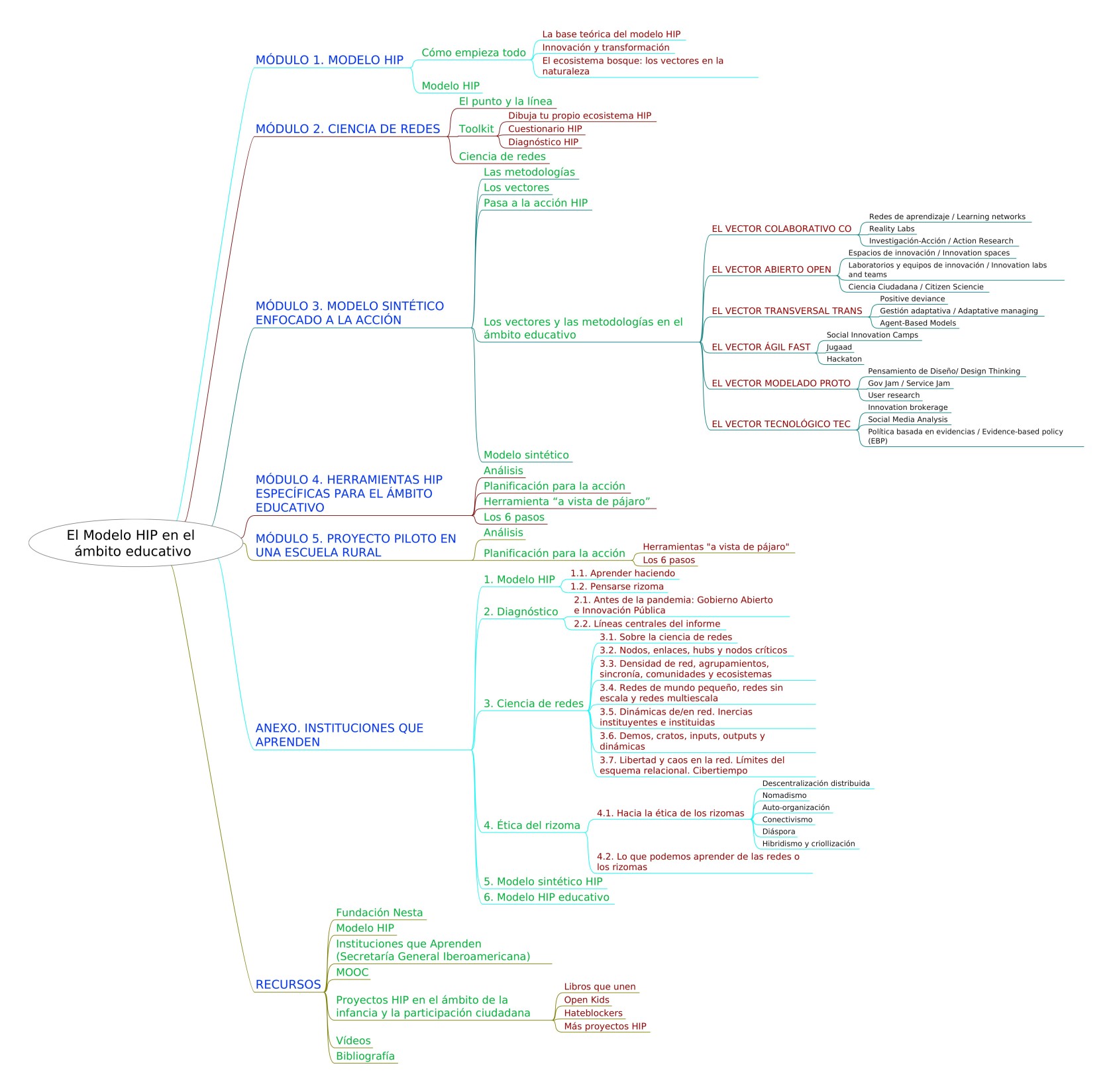
Contenidos del curso
Módulo 1: MODELO HIP
Módulo 2: CIENCIA DE REDES
Módulo 3: VECTORES Y METODOLOGÍAS
Módulo 4: HERRAMIENTAS HIP ESPECÍFICAS PARA EL ÁMBITO EDUCATIVO.
Módulo 5: PROYECTO PILOTO EN UNA ESCUELA RURAL
ANEXO: INSTITUCIONES QUE APRENDEN
[](https://libros.catedu.es/uploads/images/gallery/2022-02/Jn3modelo-hip-en-el-ambito-educativo.jpg)
Agradecimientos
Gracias a Raúl Oliván Cortés por haber sentado las bases del modelo HIP y por haberlo compartido.
Gracias a todas las [personas](https://modelohip.net/fellowhip/) que lo están aplicando y/o adaptando en sus [organizaciones](https://modelohip.net/proyectos/) con el objetivo de evolucionarlas.
Al [LAAAB](https://www.laaab.es/) por apoyar la creación de este curso y por aportar las imágenes y fotografías que lo ilustran.
Al [CATEDU](https://catedu.es/) por el interés y las facilidades para diseñar este curso e incorporarlo en la plataforma [Aularagón](https://moodle.catedu.es/) para la formación docente.
A Silvia Coscolín y Javier Domínguez por la revisión de los contenidos.
# Índice
[**MÓDULO 1. MODELO HIP**](https://libros.catedu.es/books/el-modelo-hip-en-el-ambito-educativo/chapter/modulo-1-modelo-hip-que-es-y-de-donde-surge "MÓDULO 1. MODELO HIP Qué es y de dónde surge")
[Cómo empieza todo](https://libros.catedu.es/books/el-modelo-hip-en-el-ambito-educativo/chapter/modulo-1-modelo-hip-que-es-y-de-donde-surge "MÓDULO 1. MODELO HIP Qué es y de dónde surge")
[La base teórica del modelo HIP](https://libros.catedu.es/books/el-modelo-hip-en-el-ambito-educativo/page/la-base-teorica-del-modelo-hip "La base teórica del modelo HIP")
[Innovación y transformación](https://libros.catedu.es/books/el-modelo-hip-en-el-ambito-educativo/page/innovacion-y-transformacion "Innovación y transformación")
[El ecosistema bosque: los vectores en la naturaleza](https://libros.catedu.es/books/el-modelo-hip-en-el-ambito-educativo/page/el-ecosistema-bosque-los-vectores-en-la-naturaleza "El ecosistema bosque: los vectores en la naturaleza")
[Modelo HIP](https://libros.catedu.es/books/el-modelo-hip-en-el-ambito-educativo/page/modelo-hip "Modelo HIP")
[**MÓDULO 2. CIENCIA DE REDES**](https://libros.catedu.es/books/el-modelo-hip-en-el-ambito-educativo/page/como-son-y-como-deberian-ser-los-ecosistemas-donde-se-innova "Cómo son y cómo deberían ser los ecosistemas donde se innova")
[El punto y la línea](https://libros.catedu.es/books/el-modelo-hip-en-el-ambito-educativo/page/el-punto-y-la-linea "El punto y la línea")
[Toolkit](https://libros.catedu.es/books/el-modelo-hip-en-el-ambito-educativo/page/toolkit "Toolkit")
[Dibuja tu propio ecosistema HIP](https://libros.catedu.es/books/el-modelo-hip-en-el-ambito-educativo/page/dibuja-tu-propio-ecosistema-hip "Dibuja tu propio ecosistema HIP")
[Cuestionario HIP](https://libros.catedu.es/books/el-modelo-hip-en-el-ambito-educativo/page/cuestionario-hip "Cuestionario HIP")
[Diagnóstico HIP](https://libros.catedu.es/books/el-modelo-hip-en-el-ambito-educativo/page/diagnostico-hip "Diagnóstico HIP")
[Ciencia de redes](https://libros.catedu.es/books/el-modelo-hip-en-el-ambito-educativo/page/ciencia-de-redes "Ciencia de redes")
[**MÓDULO 3. VECTORES Y METODOLOGÍAS**](https://libros.catedu.es/books/el-modelo-hip-en-el-ambito-educativo/chapter/modulo-3-vectores-y-metodologias "MÓDULO 3. VECTORES Y METODOLOGÍAS")
[Las metodologías](https://libros.catedu.es/books/el-modelo-hip-en-el-ambito-educativo/page/las-metodologias "Las metodologías")
[Los vectores](https://libros.catedu.es/books/el-modelo-hip-en-el-ambito-educativo/page/los-vectores "Los vectores")
[Pasa a la acción HIP](https://libros.catedu.es/books/el-modelo-hip-en-el-ambito-educativo/page/pasa-a-la-accion-hip "Pasa a la acción HIP")
[Los vectores y las metodologías en el ámbito educativo](https://libros.catedu.es/books/el-modelo-hip-en-el-ambito-educativo/page/los-vectores-y-las-metodologias-en-el-ambito-educativo "Los vectores y las metodologías en el ámbito educativo")
EL VECTOR COLABORATIVO CO
Redes de aprendizaje / Learning networks
Reality Labs
Investigación-Acción / Action Research
EL VECTOR ABIERTO OPEN
Espacios de innovación / Innovation spaces
Laboratorios y equipos de innovación / Innovation labs and teams
Ciencia Ciudadana / Citizen Sciencie
EL VECTOR TRANSVERSAL TRANS
Positive deviance
Gestión adaptativa / Adaptative managing
Agent-Based Models
EL VECTOR ÁGIL FAST
Social Innovation Camps
Jugaad
Hackaton
EL VECTOR MODELADO PROTO
Pensamiento de Diseño/ Design Thinking
Gov Jam / Service Jam
User research
EL VECTOR TECNOLÓGICO TEC
Innovation brokerage
Social Media Analysis
Política basada en evidencias / Evidence-based policy (EBP)
Modelo sintético
[**MÓDULO 4. HERRAMIENTAS ESPECÍFICAS PARA EL ÁMBITO EDUCATIVO**](https://libros.catedu.es/books/el-modelo-hip-en-el-ambito-educativo/chapter/modulo-4-herramientas-especificas-para-el-ambito-educativo "MÓDULO 4. HERRAMIENTAS ESPECÍFICAS PARA EL ÁMBITO EDUCATIVO")
[Análisis](https://libros.catedu.es/books/el-modelo-hip-en-el-ambito-educativo/page/analisis "Análisis")
[Planificación para la acción](https://libros.catedu.es/books/el-modelo-hip-en-el-ambito-educativo/page/planificacion-para-la-accion "Planificación para la acción")
[Herramienta “a vista de pájaro”](https://libros.catedu.es/books/el-modelo-hip-en-el-ambito-educativo/page/herramienta-a-vista-de-pajaro "Herramienta “a vista de pájaro”")
[Los 6 pasos](https://libros.catedu.es/books/el-modelo-hip-en-el-ambito-educativo/page/los-6-pasos "Los 6 pasos")
[**MÓDULO 5. PROYECTO PILOTO EN UNA ESCUELA RURAL**](https://libros.catedu.es/books/el-modelo-hip-en-el-ambito-educativo/chapter/modulo-5-proyecto-piloto-en-una-escuela-rural "MÓDULO 5. PROYECTO PILOTO EN UNA ESCUELA RURAL")
[Caso de aplicación](https://docs.google.com/document/d/1NZiPyUbDQ9hEU4XfElfPaMD1uU_5UL26EWFLAglIFRg/edit#heading=h.aggyyx6wm18m)
[Fases](https://libros.catedu.es/books/el-modelo-hip-en-el-ambito-educativo/page/fases "Fases")
[Resultados](https://libros.catedu.es/books/el-modelo-hip-en-el-ambito-educativo/page/resultados "Resultados")
Autodiagnóstico
Ecosistema
Miro
HIP en la escuela rural
Modelo HIP: de la evaluación a la acción en centros educativos
Ideación
Modelo HIP en la escuela rural
[**ANEXO. INSTITUCIONES QUE APRENDEN**](https://libros.catedu.es/books/el-modelo-hip-en-el-ambito-educativo/chapter/anexo-instituciones-que-aprenden "ANEXO. INSTITUCIONES QUE APRENDEN")
1. [ Modelo HIP](https://libros.catedu.es/books/el-modelo-hip-en-el-ambito-educativo/page/modelo-hip-jj1 "Modelo HIP")
1.1. Aprender haciendo
1.2. Pensarse rizoma
2. [ Diagnóstico](https://libros.catedu.es/books/el-modelo-hip-en-el-ambito-educativo/page/diagnostico "Diagnóstico")
2.1. Antes de la pandemia: Gobierno Abierto e Innovación Pública
2.2. Líneas centrales del informe
3. [ Ciencia de redes](https://libros.catedu.es/books/el-modelo-hip-en-el-ambito-educativo/page/ciencia-de-redes-u2P "Ciencia de redes")
3.1. Sobre la ciencia de redes
3.2. Nodos, enlaces, hubs y nodos críticos
3.3. Densidad de red, agrupamientos, sincronía, comunidades y ecosistemas
3.4. Redes de mundo pequeño, redes sin escala y redes multiescala
3.5. Dinámicas de/en red. Inercias instituyentes e instituidas
3.6. Demos, cratos, inputs, outputs y dinámicas
3.7. Libertad y caos en la red. Límites del esquema relacional. Cibertiempo
4. [ Ética del rizoma](https://libros.catedu.es/books/el-modelo-hip-en-el-ambito-educativo/page/etica-del-rizoma "Ética del rizoma")
4.1. Hacia la ética de los rizomas
Descentralización distribuida
Nomadismo
Auto-organización
Conectivismo
Diáspora
Hibridismo y criollización
4.2. Lo que podemos aprender de las redes o los rizomas
5. [ Modelo sintético HIP](https://libros.catedu.es/books/el-modelo-hip-en-el-ambito-educativo/page/modelo-sintetico-hip "Modelo sintético HIP")
6. [ Modelo HIP educativo](https://libros.catedu.es/books/el-modelo-hip-en-el-ambito-educativo/page/modelo-hip-educativo "Modelo HIP educativo")
[**RECURSOS**](https://libros.catedu.es/books/el-modelo-hip-en-el-ambito-educativo/page/recursos-hexagono-de-la-innovacion-publica "RECURSOS. Hexágono de la Innovación Pública")
Fundación Nesta
Modelo HIP
Instituciones que Aprenden (Secretaría General Iberoamericana)
MOOC
Proyectos HIP en el ámbito de la infancia y la participación ciudadana
Libros que unen
Open kids
Hateblockers
Más proyectos HIP
Vídeos
Bibliografía